White wines from Czech Republic — grapes few regions grow

Czech white wines from independent estates. Varieties like Welschriesling, Pálava, and Grüner Veltliner grown on Moravian limestone.

Moravia and Bohemia, direct from the producer's cellar.

Color (1)

Dropdown arrow

Type

Dropdown arrow

Country (1)

Dropdown arrow

Region

Dropdown arrow

Grape

Dropdown arrow

Pairing

Dropdown arrow

Sort by

Sort arrow
White
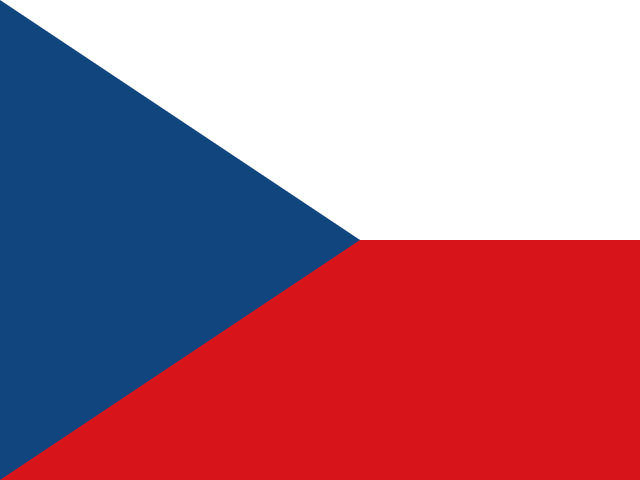
Czech Republic

Czech white wines

Most Czech white wine production is concentrated in Moravia, which accounts for roughly 96% of the country's vineyard area. The region sits at the same latitude as Burgundy but with a more continental climate — colder winters, drier summers, and a diurnal temperature shift that preserves acidity in the grape. The dominant varieties are not the ones found across the rest of Europe. Welschriesling, Müller-Thurgau, and Pálava — a 1953 cross between Tramín červený and Müller-Thurgau developed at the Velké Pavlovice research station — make up a significant share of what producers here bottle as single-varietal white wines. These are not wines your supermarket carries. They are wines your supermarket cannot carry.

Previous1 of 1Next

Frequently asked questions

How do I order Czech white wines on Free Grape Society?

Browse the listings below and add bottles to your cart. Each wine page shows the producer, region, vintage, and grape variety. Checkout is a single transaction. Wines ship directly from the producer's cellar in the Czech Republic to your delivery address.

What happens if a bottle arrives broken or doesn't taste right?

Send a photo to Free Grape Society customer support within 7 days of delivery. We will arrange a replacement or a refund. Because producers ship directly, quality issues are handled with the producer's direct involvement. Shared responsibility is built into how FGS works.

Can I order just one bottle of Czech white wine, or do I need to buy a case?

Single-bottle orders are possible. There is no minimum case requirement. You can also combine Czech white wines with wines from other countries in the same cart. Each producer ships their wines separately, so multiple deliveries may arrive from one order.

How long does delivery take?

Average delivery is 8 to 9 days from order to door. The full range is 4 to 14 days depending on the producer's location and your delivery address. Wines ship directly from the producer's cellar, not from a central warehouse.

How do I find the right Czech white wine for what I am looking for?

Use the grape filter to narrow by variety — Welschriesling and Pálava tend toward aromatic and off-dry styles, while Grüner Veltliner from Moravia runs drier and more mineral. Producer pages show the full range from each estate. Independent expert reviews on the platform give a second read on individual bottles.

How do Czech white wines differ from Austrian or German white wines?

Moravian producers work with some of the same varieties as Austria — Grüner Veltliner, Welschriesling — but the continental climate produces wines with more pronounced acidity and lighter body. Pálava is grown almost nowhere outside the Czech Republic, making it a genuinely distinct style with no direct Austrian or German equivalent.

Which wine expert can recommend a Czech white wine for me?

Browse the wine expert profiles on Free Grape Society to find someone whose speciality covers Central European or Czech wines. You can message any expert directly through the platform and ask for a specific recommendation. Expert reviews on individual Czech white wines are visible on each wine listing page.

Why don't you carry Czech white wines from every Czech producer?

Every wine on Free Grape Society is tasted by our Head of Product before it goes live. Producers also choose whether to participate — no producer is added without their own decision to list. The result is a smaller, quality-reviewed selection rather than a complete directory of Czech production.

Are Czech white wines available outside specialist wine shops in my country?

Rarely through conventional retail. Czech producers, particularly smaller Moravian estates, produce in volumes too small for standard import and distribution chains. That structural gap is part of why direct-from-producer platforms carry wines that retail shelves do not.

Key grapes in Czech white wine

Czech white wine is built on a different set of varieties than most western European countries. Welschriesling — unrelated to German Riesling despite the name — is the most widely planted white grape in Moravia, producing wines that range from dry and mineral to botrytis-affected late harvests. Müller-Thurgau accounts for a significant share of volume production, but independent producers on this platform tend to work instead with Pálava, a 1953 cross between Tramín červený and Müller-Thurgau bred at the Velké Pavlovice research station. Pálava grows almost nowhere outside the Czech Republic. Its aromatic intensity is closer to Gewurztraminer than to either parent, but with higher acidity. Sauvignon Blanc has expanded steadily in Moravia over the past two decades, with estates in the Mikulovská subregion producing examples closer in structure to Loire Valley Sauvignon than to New World styles. Pinot Gris appears under both oxidative and reductive winemaking, giving producers a wide stylistic range within a single variety. The structural diversity across these grapes means that Czech white wine is not a single style — it is a category defined by its geography and its producers' decisions, not by one dominant variety.

Regional variation in Czech white wine

Over 96 percent of Czech wine production comes from Moravia, the country's southeastern wine region. Within Moravia, four subregions are delimited by law: Mikulovská, Slovácká, Velkopavlovická, and Znojemská. Each has distinct soil composition and mesoclimate. Znojemská, in the southwest near the Austrian border, sits on granite and gneiss with a cooler continental climate. The resulting whites tend toward higher acidity and more restrained aromatics. Mikulovská runs along the Pálava hills above the Nové Mlýny reservoirs; the limestone soils and warm mesoclimate suit Welschriesling and Pálava in particular. The hills act as a temperature moderator, pulling cool air from the reservoirs across the vineyards at night, which preserves acidity even in warm growing seasons. Velkopavlovická is warmer and flatter, with heavier clay-loam soils that produce fuller-bodied whites and are better suited to varieties like Pálava and Pinot Blanc. Bohemia — the western half of the country — contains a small but distinct wine area near Mělník and Prague, where Riesling and Müller-Thurgau are grown on steep terraces above the Elbe. Volume is low and most production stays local. These regional differences are rarely communicated on supermarket labels. Producers who bottle estate wines with subregion designations are the minority — and the ones most likely to reach buyers outside the Czech Republic. No importer, no wholesaler. The price you see is the price the producer agreed to.

How Czech white wine compares

Czech white wine is structurally closer to its Austrian and Alsatian neighbors than to the dominant styles of France, Italy, or Spain. The continental climate in Moravia — cold winters, warm summers, significant diurnal temperature swings during harvest — produces the same tension between ripeness and acidity that defines Austrian whites. Where Austria built its international identity on Grüner Veltliner and Riesling, Czech producers work with a broader palette that includes several varieties found almost nowhere else in commercial winemaking. That obscurity has kept Czech white wine off most import lists. It is not a category that intermediaries have found easy to package and sell in volume. The wines that reach buyers outside the country tend to do so through direct channels — producers who choose to distribute without an importer in the chain. For context: German white wine and French white wine both reach international markets through well-established importer networks with decades of infrastructure. Czech white wine does not have that infrastructure. What it has instead is producers working in denominated subregions with documented varieties, selling directly to buyers who know what they are looking for. A bottle of wine normally changes hands three times before it reaches you. Here it changes hands once.