
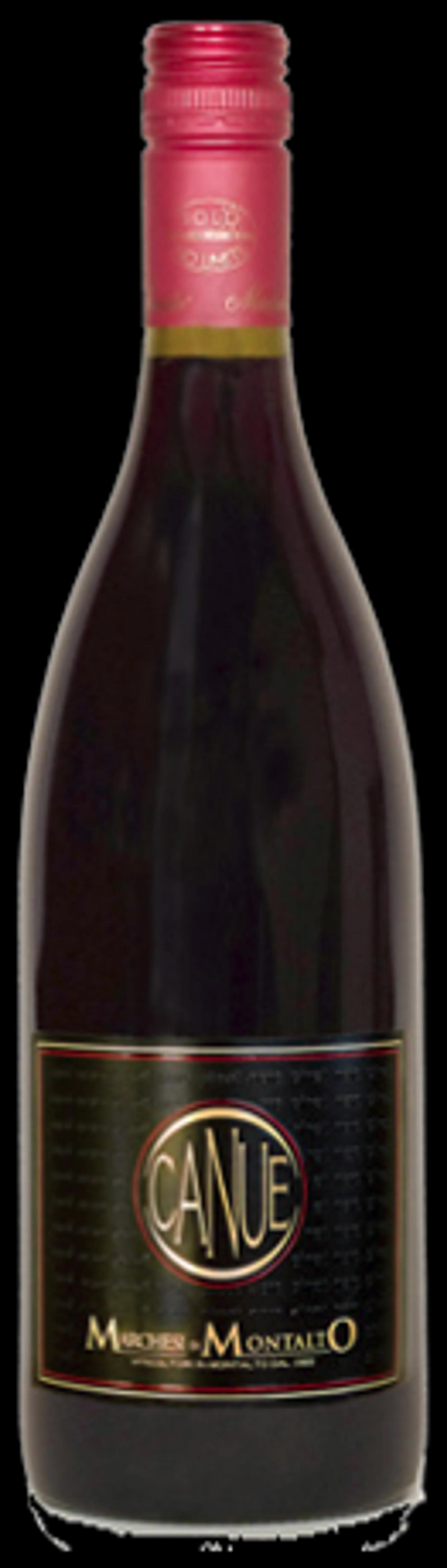
Pinot Nero Cànuè
Pinot Nero Cànuè
Price incl. alcohol tax, shipping and VAT.
Winemaker's notes
Your package will arrive at your doorstep within4 - 16 days

Marchesi di Montalto will receive and pack your order (1 - 4 days)
The courier will pick up your order and deliver it straight to your door
Product details
About the wine and its characterCountry:
Italy
Region/Subregion:
Lombardia/Oltrepò Pavese
Classification:
DOC
Certification:
-
Grape:
Pinot Nero (100%)
Vintage year:
2024
Color:
Pale ruby red color, typical of pinot noir.
Aroma:
Fruity and floral, with slight vinosity.
Taste:
Intense, soft and decisive, brings us back to small berries, currants and blackberries.
Alcohol content:
12%
Sugar content:
0 g/l
Acidity:
6
pH-value:
3
Sweetness:
Dry
Contains sulphite:
Yes
Volume:
750 ml
Closure:
Screw cap
Bottle:
Glass
Best Served:
12 - 16 °C
Food pairing:
Cheese - mild and soft, Fish - fat, Mushrooms, Pasta / Pizza, Poultry, Veal, Vegetables
Ageing potential:
0 - 2 years
Food pairings by the winemaker
- Cheese - mild and soft
- Fish - fat
- Mushrooms
- Pasta / Pizza
- Poultry
- Veal
- Vegetables
Vinification, winemaker's own words
Soils:
Clay, Limestone
Terroir:
Canue vineyard. The particles are the n. 73, 74 of 1.20 hectares planted with Pinot Noir 100% clone 115. North exposure with well-drained clayey-calcareous soils. The plants are trained in Gujot with 4200 vines/hectare.
Harvest:
Picked by hand
Fermentation:
Steel (100%)
Storage:
-
Winemaker:
-
Manual harvest in 18 kg boxes in the first weeks of September, the grapes are crushed and destemmed and put into fermentation/maceration for about 7 days at a controlled temperature of 27°. Starting from February following the harvest and after 45 days it can be sold and consumed in its maximum fragrance.
About Marchesi di Montalto
Information provided directly by the winery.

Information
Marchesi di Montalto, rooted in the early 1900s, is dedicated to wines that honestly express Pinot Noir and Riesling. With deep respect for the land in Montalto Pavese, the winery produces long-lasting wines, each named after its vineyard in the Regional Viticultural Land Registry—highlighting a strong bond between land and wine. Focused on these two varieties, the project aims to create wines that feel “healing.” The estate produces around 50,000 bottles yearly, striving for growing continuity and excellence.